If you are investing in aviation training, you want that investment to pay off in more than one way. Adding a drone certification to your pilot or dispatcher training is one of the simplest ways to do it.
It takes days, not months. It gives you a skill employers can put to work right away. And it lets you earn in aviation while you are still building flight hours. To talk through your options, contact our team or call (470) 309-4091.
Is there real demand for certified drone operators?
Yes. Businesses across the islands and beyond now use drones for work that used to need a manned aircraft, a ladder, or a survey crew, and they want operators who are trained to fly safely and legally.
Think about who needs aerial work in the Bahamas. Real estate agents want listing photos that show the beach, the dock, and the lot lines. Resorts and tour companies want marketing footage. Contractors want progress shots of a build from above.
Then there is the work that matters most after a storm. Insurance adjusters, property managers, and utility crews need roofs, power lines, and shorelines checked quickly, often where it is not safe to send a person up. A trained operator can cover that ground in an afternoon.
The common thread is trust. A client handing you a drone job wants to know you understand airspace, weather, and safe operation. Formal training is what shows them that before you ever take off.
How does drone training fit with pilot or dispatcher training?
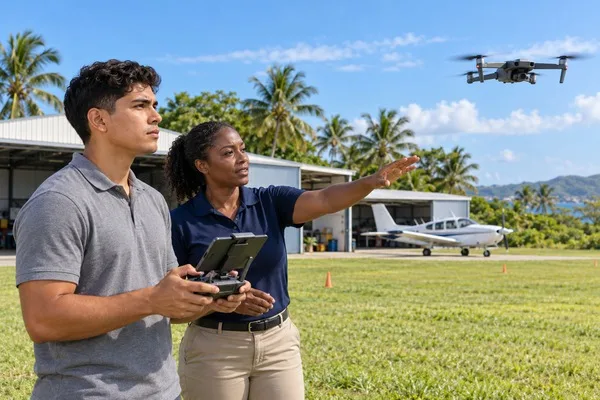
It fits naturally, because so much of what you learn overlaps. Airspace, weather, flight planning, and radio awareness all apply whether you are in the left seat, at a dispatch desk, or flying a drone from the ground.
For student pilots, the drone program adds a second way to earn in aviation. Building toward a Private Pilot License and then a Commercial Pilot License takes time, and drone work can bring in income along the way without pulling you out of the field you love.
For dispatchers, it is a practical extension of the planning mindset you already use. You are reading weather, checking restrictions, and thinking through risk before anything flies. Drone operations ask for that same discipline.
Pairing the two also makes your résumé stand out. An employer looking at a candidate with both flight courses and drone training sees someone who understands aviation from more than one angle, and that makes you easier to hire.
Who benefits most from adding the drone program?
Anyone in aviation training who wants more options when they finish. That includes student pilots building hours, dispatchers widening their skills, and people who already do photography, real estate, or construction work.
One of our students loved flying, but he also loved taking pictures of the islands. When we talked with him about drone training, his idea of what he could do with it grew fast. Photography was still on the list, but he started considering mapping and inspection work too.
He was genuinely excited about how many paths the training opened up. That is the reaction we hope every student has. One certification turned a hobby into several possible lines of work, all of them connected to the aviation career he was already building.
It also helps people who are not sure yet where aviation will take them. A short drone course is a low-risk way to gain a real, marketable skill while you decide how far you want to go with flight or dispatch training.
How do you get started with the drone program?
Start by looking over the drone program, then fill out our student application and choose the drone course. It is a 5-day course, so you can finish it without putting the rest of your life on hold.
If you are already enrolled in pilot or dispatcher training with us, ask your instructor how to schedule the drone course around your current lessons. Many students add it between training phases, when they have a short gap.
If you are new to the academy, the drone program is also a good first step in the door. You will meet our team, get a feel for how we train, and leave with a skill you can use while you plan your next move in aviation.
Bring questions about the kind of work you want to do. Real estate, inspection, mapping, and photography each lean on different skills, and knowing your goal helps us point you in the right direction from day one.
Ready to make your aviation training work harder for you? Call Caribbean Air Academy at (470) 309-4091, or send us a message to save your spot in the next drone course.