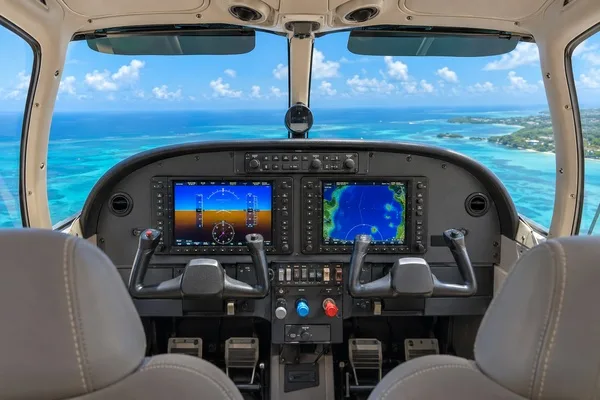
Training in glass cockpit aircraft gives students experience in modern aircraft, working with digital flight information. If you want an airline career, the aircraft you train in shape the habits you bring to the flight deck. That makes the fleet one of the first things to compare when choosing a flight school.
At Caribbean Air Academy, our students train in technically advanced aircraft from day one. Reach out to our team or call (470) 309-4091 with questions about our programs.
Why Does the Training Fleet Matter When Choosing a Flight School?
Because you learn to fly the way your aircraft is equipped. Training on modern displays and automation now makes the jump to an airline cockpit far less of a culture shock later.
Every airliner you hope to fly uses digital displays, GPS navigation, and an autopilot you will manage on every flight. A pilot who has only flown round dials has to learn a new way of scanning, a new way of programming routes, and a new relationship with automation all at once.
A pilot who trained on glass from the start has already built those habits. Reading a primary flight display, briefing a GPS approach, and deciding when to let the autopilot fly become routine instead of new.
So when you compare schools, look past the price and the brochure. Ask what each aircraft actually has in the panel and which phase of training uses it. Our school operates out of Nassau, on Pitt Road, and our flight courses page lists the aircraft and the courses side by side.
What Aircraft Will You Train In?
Our training fleet includes the Tecnam P2010 with a Garmin G1000 panel and Cessna 172 trainers equipped with a Garmin G5, GTN navigators, and a GFC 500 autopilot.
The Tecnam P2010 is a modern four-seat single-engine trainer. Its G1000 is a fully integrated glass cockpit, with a primary flight display in front of you and a multifunction display for maps, engine data, and navigation. It is the kind of layout that prepares you for larger integrated flight decks.
Our Cessna 172s are technically advanced aircraft built on a familiar airframe. The G5 is an electronic flight instrument that shows attitude and other flight data digitally. The GTN 650Xi and GTN 750Xi are touchscreen GPS navigators that handle routing, approaches, and communication.
The GFC 500 is a digital autopilot that can fly the airplane along the route or approach you program. Learning to set it up, monitor it, and take over smoothly is one of the most useful skills you can carry from training over New Providence into a professional career.
How Does Technically Advanced Aircraft Build Automation and Instrument Skills?
It builds those skills a little at a time across every course. You learn the displays early, use them in earnest during instrument training, and manage them like a professional by the commercial stage.
In the Private Pilot course, you learn to read glass displays and fly the airplane by hand. Automation is a tool, not a crutch, so stick-and-rudder skills come first.
The Instrument Rating is where the panel really earns its place. You fly GPS approaches, brief procedures on the navigator, and practice coupling the autopilot to an approach. You also learn what to do when the automation does not do what you expected.
In the Commercial Pilot course, you refine precision and decision-making in the same environment. Our Professional Pilot Program brings it together in one path that covers the Private Pilot License, Instrument Rating, Multi-engine Rating, and Commercial Pilot License. All programs are administered under FAA Part 61 rules. See our FAA pilot courses for details.
What Should You Ask a Flight School Before You Apply?
Ask how the fleet lines up with each stage of training. The answers tell you whether the aircraft really support the career you are aiming for.
Start with which aircraft are used for which course, and whether glass-cockpit aircraft are part of instrument training. Ask how instructors balance hand flying with automation, so you build both skills. Ask how scheduling works, and how the school keeps students flying steadily rather than waiting between lessons.
Then ask about the full path. A program that carries you from your first lesson through your commercial certificate in the same style of aircraft keeps your habits consistent. That consistency makes the move into a professional cockpit easier.
Ready to take the next step? Review our courses, then submit your student application, or call (470) 309-4091 to talk with our team about which program fits your goals.